Search CDOQ

Loading...

Sunday, May 11, 2008

Evolution of Applications and Bandwidth
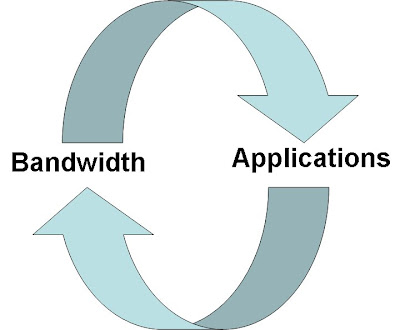
Let's go back in time just a few years. The days when social networking was done in person:-)Think about the dial-up/AOL days. There was not much you could do on the Internet except email and read web pages (Web 1.0). In those days average speed was less than 56kpbs and now the average broadband speeds in the US are between 2Mbps and 5Mbps. Even if you take the lower number i.e. 2Mbps it is 35x increase over what we had 10-12 years ago. The new applications have increased in the same proportions. For example-Youtube, social networking, Grid computing, online gaming, flickr, tagging, blogs, movie downloads, second life, etc. etc. And, Web 1.0 has evolved to Web 2.0. Most of these applications evolved to become popular (widely adopted) because of increased bandwidth availability. Similarly there are applications (mutations) being created today which will evolve to become popular when the bandwidth availability increases from the current levels.


Bandwidth and Applications create an infinite loop i.e. co-evolve. Bandwidth enables the creation of new applications and new applications need more bandwidth to evolve. The additional bandwidth then creates even more new applications which need even more bandwidth to evolve. And so on.

For the first time in history, we have ability to do mass collaboration irrespective of location. Imagine the possibilities it will create. We have only seen the tip of the iceberg.

Some say that making predictions is dangerous especially if it is about the future:-). In 1981 Mr. Bill Gates said, "640K ought to be enough for anybody." I am predicting that in the foreseeable future, the demand for bandwidth will continue to rise as current applications evolve and new applications are born.

What I explained above is millions of year old concept found in biology. Applications-Bandwidth have Predator-Prey relationship. Applications "eat" Bandwidth for survival and they co-evolve. As in biology, the predator species which collaborate get to eat most of the preys, the P2P applications "eat" up to 90% of all bandwidth. P2P (Peer to Peer) is a good example of mass collaboration. Also, as the big (complex) predator species eat more, the complex applications (video) eat more bandwidth. As both applications and bandwidth evolve to adapt to the new environment, the earlier versions for both continue to decline and will eventually die. Dial-up bandwidth connections are on decline and Web 1.0 sites are on decline.

I find it fascinating how the fundamental concepts from one field can be applied to another field. Given enough knowledge, one can develop Universal concepts. This is what Complex Systems (CX) teaches you. To learn more about CX, please visit necsi.org

Your thoughts?

Tuesday, May 6, 2008

55 Learnings from Warren Buffett and Charlie Munger

Friends, after attending the Berkshire Hathaway shareholder meeting last year, I went back again this year with my friend, Shriniwas. Once again, it was a wonderful experience. Please see the notes/learnings below:


1. Read everything in sight. It is the best way to learn.

2. You only have to remember three principles to become a good investor:

i) You are buying part of the business when you buy stocks (so, understand the business you are buying)
ii) Leave margin of safety (i.e. if you think a business is worth $100, buy it at $60 and not at $99)
iii) Market is there to serve you and not to instruct you (use the market to buy undervalued businesses)

3. The reason good investing principles are not taught in business schools and the complex formulas are taught is that people like to teach what they know and not necessarily what the students need to know. E.g. If someone told you that all biblical studies boil down to 10 commandments and that is all you need to be taught then you would not need many teachers.

4. The business schools only need to teach two things in investing:

i) how to value a business
ii) how to use the stock market to serve you

5. When hiring people look for passion and communication skills. Most candidates know what the interviewer wants to hear. Retention contracts with employees do not work. Passion works. At Berkshire, people are hired when a business is bought and we (Warren/Charlie) focus on retaining employees by providing an environment to keep their passion alive. The reason people stay with Berkshire is more than money.

6. Never trade reputation for money.

7. A lot of game playing occurs in Corporate America and Wall-Street via quarterly guidance and pressure to meet targets. Businesses should be focused on long term. Berkshire managers have no pressure to meet any EPS targets or to meet any budgets.

8. Do what you like and you will always be mentally and physically healthy.

9. Don't sleep-walk through life. Find your passion and you will live a much happier life.

10. Work for people you admire.

11. Communication skills are extremely important in life and they are under-taught at the universities.

12. Berkshire made all its money on "longs" and no money on "shorts."

13. Do what you understand and do it consistently. Overtime, you will become very successful.

14. It is the nature of things that most small businesses will remain small and most big businesses will become mediocre and die.

15. The best investment Berkshire ever made was the recruitment fee paid to the executive research firm to hire Ajit Jain (he manages Berkshire's reinsurance business).

16. Buy businesses that produce cash (no continued reinvestment of cash is required to sustain the business)

17. Stock market gives you bargain price but the individual owners don't.

18. Price is always important.

19. US$ will weaken further in future and Euro is not likely to depreciate anytime soon.

20. Investment possibilities are inversely proportional to the amount of money you have i.e. more money = less possibilities and less money = more possibilities

21. Invest in a business which an idiot can run because sooner or later one will.

22. Political process in the US is corruptive. You have to make the other guy look bad. However, it works. If you don't follow the process you may win a medal for bravery but you will not win the presidency.

23. With small sums of money it is a mistake for a professional investor not to put most of it in one good idea.

21. The best investment for a "know nothing" investor is a diversified index fund with a low fee. Diversification does not make sense for a professional investor.

22. Oil production will be down from the current levels in 25 years (and energy demand will be tremendously higher).

23. Corn fuel is the dumbest idea.

24. Live within your income.

25. CEO is the chief risk officer of the company as well. It is the CEO's job to manage risks the company is exposed to.

26. "Derivatives" are very hard to manage.

27. The accounting profession has failed us (Americans). The accounting standards should not be designed to please everyone. They should be designed like engineering standards.

28. If you have to carry the value of a deal/investment to three decimal places then it is not a good idea.

29. In a complex environment, you can not make a fine grade decision. Try to be in the right ball park.

30. Due diligence by external partners is a waste of time. No one knows your business better than you do. Risk evaluation can not be farmed out.

31. A brand is a promise which stays in your subconscious. Hence, a branded product with a leadership position over a long time in the market is a good investment.

32. To understand the qualities Berkshire is looking for in Warren Buffett's replacement, read Berkshire 1996 annual report.

33. In the complex business world we live in today, one of the most important attributes of a CEO is to contemplate scenarios/problems which have never happened before.

34. The people who are supposed to warn CEOs of risks try to make CEOs feel good while CEOs do dumb things. And these people try to modify reality to fit it into complex financial models. Despite all the risk modeling, Bear Sterns failed.

35. It is OK to sacrifice a little bit of earnings to minimize risk.

36. Berkshire is run like an engineering company.

37. Don't worry about the things you have missed.

38. Punishing China via Olympics boycott is a mistake. China is moving in the right direction and people who move in the right direction should be encouraged and not punished. US has had its share of human rights violations. US constitution used to say that blacks are 3/4 of a person.

39. There are more banks than bankers.

40. The secret of nuclear power has been leaked. The ability of "nuts" to inflict massive damage is increasing. The world is becoming a more dangerous place.

41. The best investment you can make is in yourself. Human potential is not realized in most people. Any investment in learning always pays off.

42. Warren Buffett tells this story to high schools grads. Imagine you can buy any car you like with a catch that you can not get another car for thirty years. What will you do? You will change the oil more than required. Get it washed regularly. In a nutshell, take very good care of it. Now, why wouldn't you do the same thing with your body.

43. Beware of vendors and lenders.

44. Don't give away the money you need.

45. In Wall Street there is no testing done before launching a new product. Wall Street operates very differently than the drug industry where rigorous testing is done before a product is launched.

46. Even though US consumers live on credit unlike Asians who save half their earnings, the US has become a richer nation in the last ten years.

47. Current US trade deficit is $700B and $47k/person GDP.

48. Assets of the Investment Banks have become "good until reached for."

49. The phrase, "financial innovation that will diversify risk", should be banned. It will tremendously help the financial industry.

50. Americans have love affairs with their cars. It is unlikely that we will see expansion in mass transit in the US."Human nature does not change. "

51. Credit Default Swap (CDS) are a negative sum game.

52. The company should only provide dividends if it does not have the ability to convert a $1 into $1.1 or more.

53. You teach children by what you do and not by what you say. There is no reverse button in children's learning.

54. The press has more influence on executive behavior than regulation since the "big shots" don't like to be embarrassed.

55. Copy the qualities of people you admire.

You may notice that both Warren Buffett and Charlie Munger used the word complex many times. In my opinion, for anyone to understand the world and solve any complex problem-business, social, scientific, etc, it is critical to understand Complex Systems. To learn more about Complex Systems, please visit http://necsi.org/

Your thoughts?


Monday, May 5, 2008

Improving human relations

One of my yearly objectives this year is to get better at forming emotional connections with people. So, I read a book which Warren Buffett read to become one of the most admired business leaders. It is a book published in 1931 called How to win friends & influence people by Dale Carnegie.

Although I have been practicing most of the principles, I have slipped few times:-) It is amazing that the book was published 77 years ago and the principles are still effective. I have listed the principles below. Please keep in mind that some of the principles may not work outside the US.

Fundamental techniques in handling people:

1. Don't criticize, condemn or complain

2. Give honest and sincere appreciation

3. Arouse in the other person an eager want

Six ways to make people like you:

1. Become genuinely interested in other people

2. Smile

3. Remember that a person's name is to that person the sweetest and most important sound in any language

4. Be a good listener. Encourage others to talk about themselves

5. Talk in terms of other person's interests

6. Make the other person feel important-and do it sincerely

Win people to your way of thinking:

1. The only way to get the best of an argument is to avoid it

2. Show respect for the other person's opinions. Never say, "you are wrong"

3. If you are wrong, admit it quickly and emphatically

4. Begin in a friendly way

5. Get the other person saying "yes yes" immediately

6. Let the other person do a great deal of talking

7. Let the other person feel that the idea is his or hers

8. Try honestly to see things from the other person's point of view

9. Be sympathetic with the other person's ideas and desires

10. Appeal to the nobler motives

11. Dramatize your ideas

12. Throw down a challenge

Be a Leader:

1. Begin with praise and honest appreciation

2. Call attention to people's mistakes indirectly

3. Talk about your own mistakes before criticizing the other person

4. Ask questions instead of giving direct answers

5. Let the other person save face

6. Praise the slightest improvement and praise every improvement. Be "hearty in your appreciation and lavish in your praise"

7. Give the other person a fine reputation to live up to

8. Use encouragement. Make the fault seem easy to correct

9. Make the other person happy about doing the thing you suggest

If everyone follows these principles, we would become a better society.

Your thoughts?