Posts

Showing posts with the label marketing

Deploy Bravely?

Image
Driving down Hwy 101 in Silicon Valley yesterday, I spotted this billboard (See image). It reminded me that while the Bay Area overflows with technical brilliance, tech companies often stumble when it comes to marketing and communication. The ad boldly declares: “DEPLOY BRAVELY.” Deploy Bravely? In software, deployment is the last place you want bravery. A good deployment should be boring—built on testing, quality assurance, monitoring, and the ability to roll back instantly if things go sideways. Sonos once deployed bravely and left some of its speakers effectively unusable.  The bravery resulted in the company’s market cap declining by half. I have no idea what Prisma Airs is—and the ad doesn’t make me interested in finding out more. Can you tell what it’s about?

Why Selling GenAI Feels Nothing Like SaaS

Image
Earlier this week, at a roundtable hosted by Chargebee , a group of GenAI (AI) founders compared notes on a shared learning: building and selling AI products to businesses is not just harder than selling SaaS — it is "fundamentally different'. Many entered the market expecting to ride the SaaS (Software as a Service) playbook to success. They are now discovering it’s written in a different language. Here are five reasons why: 1. The Vanishing Customer Profile In SaaS, identifying the Ideal Customer Profile (ICP) is often straightforward: a clear job to be done, a known budget holder, and measurable ROI. In GenAI, that clarity dissolves. Everyone wants to “experiment with AI.” Few want to commit. Interest is high, intent is elusive, and trial usage often masks the absence of a real buyer. 2. The False Promise of PLG Product-Led Growth — the darling of modern SaaS — is stumbling in the AI world. While PLG drives traffic and trials, it fails to convert at scale. AI products often...

Navigating B2B Marketing With Precision And Strategy

Image
The Complexity of B2B Decision-Making B2B marketing isn’t about impulse-driven purchases—it’s about navigating a maze of stakeholders, each with different priorities. A CRM software purchase, for instance, must satisfy the CFO’s cost concerns, the CRO’s sales enablement needs, the CIO’s security requirements, and the CEO’s strategic vision. These competing perspectives make sales cycles longer and more complex, demanding that marketers craft tailored, high-impact messaging. Evolving Buyer Personas: From Static to Dynamic For years, B2B marketers have relied on buyer personas—fictional representations of ideal customers based on roles, challenges, and goals. Personas like "Strategic Sarah" (VP of Operations focused on efficiency) or "Risk-Averse Richard" (Head of Procurement prioritizing compliance) help humanize audiences. However, traditional personas are often too rigid. Today, AI-powered insights allow for real-time persona refinement, using behavioral data, sent...

Testing New Product Ideas - The MBR Way

Image
In Silicon Valley, the product development approach of releasing the most basic version of the product ( Minimum Viable Product or MVP ) to some users who would find it valuable compared to available options and then iterating the product based on user-feedback, is well understood. In the CPG ( Consumer Packaged Goods ) world, the approach of testing a new product idea before any development work is done is practiced regularly. It might be hard to develop an MVP for a new soap but we, in the technology product development, can test new product ideas before we start building an MVP. Performing this test also helps with positioning the product in the market. Following is the three step MBR ( M ental model, B enefit, R eason to believe) approach of testing new product ideas:  Testing new product ideas  Start with writing down the singular product idea and then follow the three step MBR process in writing.  1. M ental model: How do users think about the product cate...

Changing P in CPG: Packaging In The Direct-To-Consumer World

Image
Consumer Packaged Goods (CPG) or Fast Moving Consumer Goods (FMCG) are goods that consumers buy frequently like food, beverage, makeup, household products, etc. It is an over two trillion dollar industry in North America. Some of the well-known CPG companies are Coca-Cola, Pepsi, Procter and Gamble, Colgate-Palmolive, Unilever , etc.  CPG aisle in store (Source: Wikipedia) It is hard to create a highly differentiated product in the CPG space. For example, soap is soap for most people. Some might want to avoid buying soap with triclosan  but it is difficult to make a soap 10x better than an average soap and charge a reasonable price. Or, think of bottled water. There are over one hundred different brands which differentiate based on where the water is from and the packaging. For many CPG companies, half the sales come from WalMart so which retailers carry your products is important. There are mainly five different ways in which CPG companies different...

What Drives Our Social Behavior?

Image
Why do we do anything? Why do we want anything? What leads to our actions or inactions? What makes us social? Why do we compromise? Some say that human life is driven by fear. It is fascinating how society functions and how many variations there are of society.  However, the core of human nature is the same all over the world. In my observations, our social lives are highly influenced by three distinct fears -LLP:  1. Fear of L oneliness 2. Fear of Effort ( L aziness)  3. Fear of the Unknown ( P redictability)   Evolutionary biology tells us that a desire to procreate and to self-preserve dictate a lot of our behavior. I think the modern world is much more complex. Reliance on another human is being replaced by commercial goods and services. Time is our most limited resource and it is primarily consumed to earn money and/or to satisfy our senses. Is that all there is? Let's see how LLP plays a role in our daily social lives:  ...

Apple Watch: A Giant Leap for Apple. A Small Step for Wearables

Image
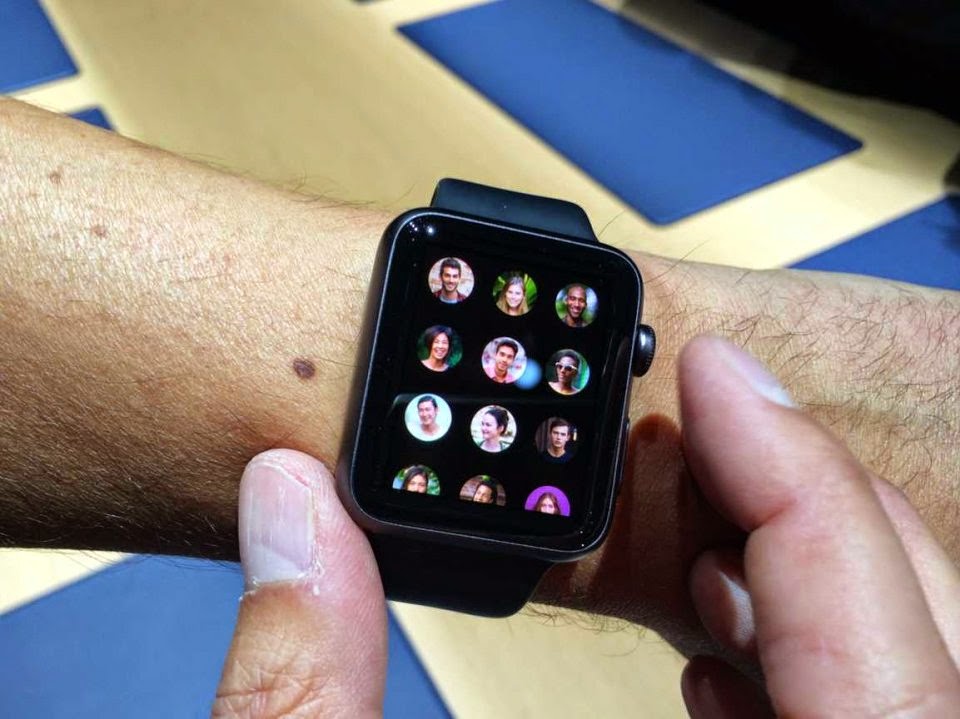
Apple Watch Beautiful is not the word that comes to mind when you look at the new Apple Watch (AW) . You don’t think of cool, edgy, or sophisticated either. The AW, formerly rumored as the iWatch, is out or, at least, we have an idea of what it is. Well, it looks like a watch and does a lot of other stuff. It blows away anything else that is in the market in the wearable/smartwatch/fitness-tracker/health-monitor category.  Google Android Wear  and  Samsung Gear  look ancient in comparison. However, it fails to evoke the emotion that Apple's other successful products like the iPhone evoked. Surprisingly, Apple failed to create an elegant design that is sophisticated, inviting, and  moving. The AW looks like a giant screen on your wrist.The AW comes in two sizes. The bigger one is for men and the smaller one is for women.  Apple does not state that explicitly, though. Some men may like it but I cannot imagine a fashion-conscious woman we...

New Tribal Knowledge for Startups

Image
7 Heuristics (experience-based techniques for problem solving) for Entrepreneurial Success Innovation is about creating  new   things. But how do you create new things that people are willing to use and pay for? Ambiguity and uncertainty are always associated with innovation. Generally, people have a tough time dealing with both. One of the reasons that big corporations are not good at creating new things is that they are not structured to do unpredictable things -  a hallmark of the startup environment . There is no predictability when creating a new business with an idea.  Startup is a complex system problem because creating a successful business depends on the interplay amongst the idea, market, people, and capital. The outcome is unpredictable and it can change the world.  The unknowable can only be understood by doing  When you are starting a company or developing something new, you have an idea, you may have a...