Posts

Showing posts with the label leadership

11 Tenets Of A Good Product Manager

Image
Most product managers don’t fail because they lack ideas; they fail because they don’t make the right trade-offs. Over the course of my career, I’ve led product organizations building everything from 0→1 products to businesses generating over $600M in revenue spanning hardware, software, AI, and crypto. What I’ve found is that while the domains evolve, the craft of product management remains fundamentally the same. In the fast-paced world of product development, the job of a product manager is not to optimize for a single objective but to balance competing forces. I’ve found that good product managers consistently operate across four objectives:      A. User Experience      B. Profit (Unit Economics)       C. Competitive Advantage      D. Technology Advancement Read more about the four objectives here . The most common mistake product managers make is optimizing for one objective at the expense of the others. These objecti...

Empathy

A leader’s empathy for employees should not exceed the team’s empathy for customers.

More Or Less

Leaders who want to do more with less have been doing less with more. 

Leraning

Like children, employees often learn more by observation than by instruction.

The Business Outcomes Matrix: Decoding Strategy and Team Dynamics

Image
Why do some companies thrive while others falter? This question captures the essence of business strategy and is crucial for every business leader and investor. The key to success often lies in the dynamic interplay between a company's strategic direction and its executive team's ability to execute. Using the business outcomes matrix below,  we will explore a framework that provides insights into this question. Business outcomes matrix Understanding the Matrix This matrix is divided into four quadrants, each representing a unique combination of the quality of your strategy and the strength of your team: 1. Failure (Bad Strategy, Bad Team) This quadrant represents the worst-case scenario for any company—having both a poor strategy and an ineffective team. A bad strategy might involve misreading market trends, focusing on the wrong customer needs, or failing to differentiate from competitors. Coupled with a team that lacks the necessary skills, vision, or drive, companies in this...

Problems

Immature leaders tend to solve hypothetical problems at the expense of real problems. 

My Business Operating Principles

Image
How do you effectively lead an organization? There's no one-size-fits-all answer. It depends on various factors, including the organization's size and industry, your leadership style, the experience of your management team, and more. Throughout my career, I've held various management roles (GM, CEO, CPO, VP, etc.) in organizations ranging from startups to those generating $100 billion in annual revenue. This experience has allowed me to develop a set of guiding principles that I not only operate by, but also share with my teams. They are: 1. Ready. Shoot. Aim Thanks to Sam Walton , founder of Walmart, for this principle. This mindset was instrumental in the growth and success of Walmart, as it fostered a culture of experimentation, rapid response to market demands, and continuous improvement. It means that you should prepare to take action and, instead of spending time in deliberation and planning (aim), take action (shoot) and iterate your way to the target. 2. Understand...

My Management Philosophy

Image
As a business manager or business executive, I have been managing teams for over 20 years and have developed a simple management philosophy. I and everyone I work with should have fun, learn, and contribute to the growth of the organization. These three cultural attributes are defined as follows:  Joy of working (image credit: Canva AI) Have Fun Enjoy your work Enjoy problem solving together with your teammates Enjoy sharing your knowledge Opportunity to work on things not directly related to the job but still good for the organization Maintain balance Learn Learn what is necessary to do the job better Learn about the topics that interest you Feel safe to make mistakes and learn from them Learn how to collaborate better with your teammates Learn how to communicate more effectively Contribute to the growth of the organization Deliver results based on your goals (that can be changed with new data) Understand how your work is contributing to the growth of the organization Offer new id...

Thinking

Business executives would do better by spending more time thinking. 

Interesting Excerpts From The Books I Read In 2020

Image
I spent most of the 2020 at home and I thought that it would result in a lot more reading than usual (~12 books a year).  I was wrong but not entirely, I read 14 books last year:)  2020 Books  Following are some random and interesting excerpts:  1. The Worldly Philosophers   There is a "preanalytic" process that precedes our logical scenarios, a process which we cannot escape, and which is inescapably colored with our innermost values and preferences. "Analytic work", writes Schumpeter, '...embodies in the picture of things as we see them, and whenever there is any possible motive for wishing to see them in a given rather than another light, the way in which we see things we can hardly be distinguished from the way in which we wish to see them.  2. Technology Strategy Patterns  When the good leader's work is done, his aims fulfilled, the people will all say, "We did this ourselves." - Lao Tzu  Definition of [technology] archite...

Data And Decision Making

Image
The underlying assumption in data-based decision making is that the future will be the continuation of the past. The big companies have all the data in the world and somehow meaningful innovation comes out of startups which are based on the founders' believes, intuition, or curiosity. All data is about the past including the data about the future, which is more of an opinion than fact. Does that mean we ignore data? No. Understand the data about the data. Where does it come from? When and how it was collected? Is it showing causation? Do we understand the interconnectedness of all variables? etc. And then, use data as one of the inputs in decision making.  Was controlled fire invented based on data? :) 

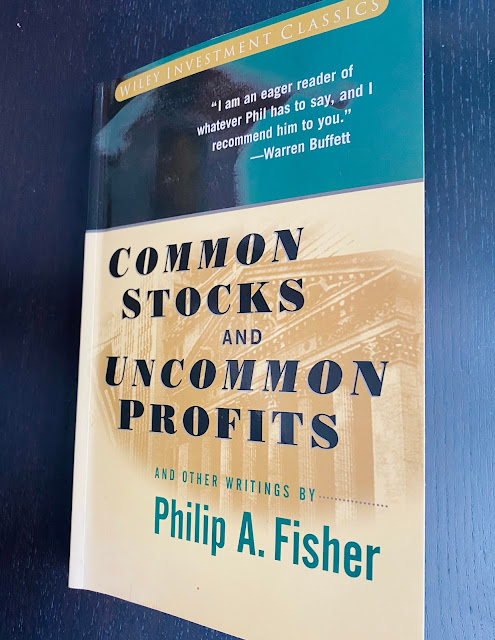
Phil Fisher's 15 Questions

Image
Phil Fisher was an investor who pioneered the style of investing (stocks of publicly traded companies) based on growth prospects of companies as opposed to finding companies which might be undervalued. He used the following qualitative approach to evaluate  what stocks to buy:  A classic  1. Does the company have products or services with sufficient market potential to make possible a sizable increase in sales for at least several years?  2. Does the management have a determination to continue to develop products or processes that will still further increase total sales potentials when the growth potentials of currently attractive product lines have largely been exploited?  3. How effective are the company's research and development efforts in relation to its size?  4. Does the company have an above-average sales organization?  5. Does the company have a worthwhile profit margin? 6. What is the ...

The Okinawa Problem

Image
Yesterday, I met the governor of Okinawa, Japan,  The Honorable Denny Tamaki , who is visiting the US to gain support for decreasing the US military presence in Okinawa.  Governor Tamaki, who is half American, has a really hard job. Relocation of the Marine Corps Air Station Futenma has been in works for the last five decades. The Okinawa people don't want the base to be relocated to Henoko Bay within Okinawa for various reasons. The Japanese central government says that the current Okinawa governor has to honor the agreement signed by the previous governor who agreed to the relocation. The US government says that it is an internal Japanse matter and they don't want to interfere. 76% of the Okinawa population expresses opposition to building of a new base in Henoko Bay. What is a governor to do? He is traveling in the US to convince the congressmen and political advisors to gain support for the move of the US Futenma base outside of Okinawa. Maybe to Guam.  ...

Pivot And Its Challenges

Image
In the startup world, things rarely go as planned and in the corporate world things change that require the business to change. All organizations, startups and corporations, have to respond when something threatens their existence. Generally, the response is a change in direction of the organization i.e. doing something significantly different than the status quo. It has become common to call this change in direction as pivot.  Why pivot? There are four main reasons an organization needs to change direction:  1. Disproved Hypothesis: This reason is more applicable to startups and the corporations launching new products. Founders create a startup with an idea in mind and they believe that there is a market for that idea. When you start building the product, you figure out that that the idea can not be converted to a scalable product or the product development might go alright and you find out that there is no market for the product. What do you...