Posts

Showing posts with the label warren buffett

Institutional Imperative

"The institutional imperative, the tendency of executives to mindlessly imitate the behavior of their peers, no matter how foolish it maybe to do so...One of its main tenets is a copycat mechanism that decrees that any craving of a leader, however foolish, will be quickly supported by detailed rate-of-return and strategic studies prepared by his troops. For example, every time it becomes fashionable to expand into some new line of business, some companies will expand into it. Then they get out of it about five years later, licking their wounds.  I did not intuitively understand it when I entered the business world, I thought that decent, intelligent, and experienced managers would automatically make rational business decisions. But I learned over time that isn't so. Instead, rationally frequently wilts when the institutional imperative comes into play.  For example...As if governed by Newton's First Law of Motion, an institution will resist any change in its cur...

My Errors In Investing

Image
I am writing this post to internalize the lessons learned from my investing (in public companies) mistakes over twenty years.   Chapter 1 (2000 - 2003) My journey of investing in public companies began around year 2000, at the peak of the  dotcom bubble . At the time, all I remembered about investing from my recent MBA was that companies trading over a  P/E  (Price Earnings Ratio i.e. price of the stock divided by earnings per share) of 15 were overpriced. People were very excited about investing at the time, stocks were what everyone talked about in social gatherings. I worked with people I liked and respected. They were making money every day in the market and how much money everyone was making was the lunch topic every day. I brought up P/E ratios in the conversations and they all laughed and said it was a new economy, old rules didn't apply. I thought this is why people say that reality is different from school. I was applying what I learned in sch...

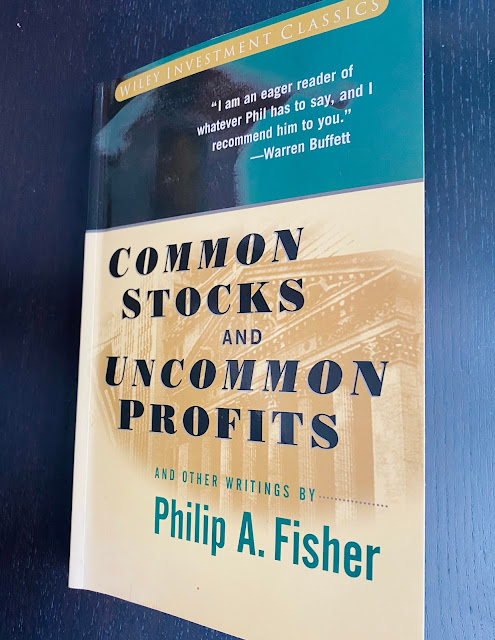
Phil Fisher's 15 Questions

Image
Phil Fisher was an investor who pioneered the style of investing (stocks of publicly traded companies) based on growth prospects of companies as opposed to finding companies which might be undervalued. He used the following qualitative approach to evaluate  what stocks to buy:  A classic  1. Does the company have products or services with sufficient market potential to make possible a sizable increase in sales for at least several years?  2. Does the management have a determination to continue to develop products or processes that will still further increase total sales potentials when the growth potentials of currently attractive product lines have largely been exploited?  3. How effective are the company's research and development efforts in relation to its size?  4. Does the company have an above-average sales organization?  5. Does the company have a worthwhile profit margin? 6. What is the ...

Valley Nordic Episode 2: UBER, LYFT, And Berkshire Hathaway

Image
In this episode, Arne and I talk about UBER (valuation, how will they make money) which is going public tomorrow,  LYFT (valuation, operations) which announced 1Q 2019 earnings earlier this week. How Uber and LYFT are different, how capital markets have changed and have led to startups going IPO with losses and unpredictability about their businesses. And, we touch on my favorite shareholder meeting, which was held last week, i.e. Berkshire Hathaway.  S ubscribe to the podcast on  Apple Podcasts ,  Google Podcast , and  Spotify .  Or, l isten to the podcast  here . See the previous episode notes at  https://cdoq.blogspot.com/2019/05/valley-nordic-new-podcast.html

Lessons Learned From Shorting Amazon

Image
Although I have an MBA, my learnings about investing come from Charlie Munger and Warren Buffett, Vice-Chairman and Chairman of Berkshire Hathaway Inc. I have attended Berkshire Hathaway shareholder meetings about dozen times and the four basic rules of investing that I have learned are:  Do you understand the business you are buying (think of buying stock of a business like buying the entire business)?  Can you predict the earnings of the business for the next five to ten years?  Does the business have a competitive advantage (i.e. does the business have something that a competitor would find hard to copy)?  Is the stock fairly priced?  Amazon headquarters in Seattle, WA. Photo Credit: Wikipedia These four rules are easy to understand and hard to implement. A few years ago, when Amazon stock was trading below $300 and its  P/E  (Price to Earnings ratio), which is one way to determine if the stock is fairly priced, was above 2,000. ...

50th Year of Wisdom from Buffett and Munger

Image
On May 2nd, 2015, I was in Omaha to participate in my annual ritual of attending the Berkshire Hathaway annual shareholders meeting. I like Warren Buffett and I absolutely adore Charlie Munger. Both are my heroes. They are full of wisdom and have shaped my thinking. 40,000 people standing in line to get into a shareholder meeting!  Following are highlights from the meeting: Human Behavior 1. For some reason, no-haggling business breaks down after a while. People say that they don’t like to negotiate but they like getting a deal especially on big-ticket items. 2. “If people were not often wrong, we would not be so rich.” – Munger 3. There is no formula for buying businesses. Do business with people you trust. 4. When ego is involved people tend to do things that they are not supposed to do. 5. Jack Ringwalt, former CEO of National Indemnity, used to yell at his subordinate every time he brought the news of claims to be paid. The subordinate did not like to be yel...